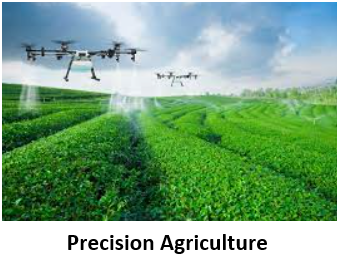
Precision Agriculture and the Farming Revolution
The world is at the edge of the third modern farming revolution and precision farming is an important part of it. The first farming revolution that occurred from 1900 to the 1930s, mechanized agriculture leaving each farmer able to produce enough for 26 people. Long after that, it was the 1990s when the second revolution known as the Green revolution took place. Due to scientific progression genetically modified newer sets of crops that are pest resistant and need less water were introduced, leaving each farmer able to feed 155 people. The global population is expected to reach 9.6 billion by 2050 and food production must be double the current levels to feed every person. Advanced analytical capabilities and constantly improving IoT capabilities, like precision agriculture drones, will be key elements in the third revolution. But how is Precision Agriculture different from what farmers and agri-businesses have already been doing?
Precision Agriculture vs Traditional Cultivation
Precision Agriculture and traditional cultivation differ vastly in practice. In traditional agriculture, farmers apply the same amount of pesticides, fertilizers, and irrigation across fields, at prescribed times and frequencies, as per the general recommendations for the region. However, there are always differences in biological, physical, and chemical parameters even within a single field. Uniform treatment of fields without considering inherent differences results in the overuse of inputs in fertile land and underuse in poor patches. This inefficient use of land, water, fuel, fertilizers, and pesticides increases cost and environmental impact.
Before installing automatic irrigation
Develop a whole farm plan for your property. During the development of the farm plan, consider automatic irrigation in the planning process so you can incorporate some of the features required for automation from the start. This might involve design of the channels for channel automation if possible — or it might be the use of bay outlets and other channel structures that will suit automation at a later stage.
Precision Agriculture and Predictive Farming
According to McKinsey, the invention and adoption of Precision Agriculture is shaped by the following trends- Big Data and Advanced Analytic Capabilities, and Robotics — aerial imagery, sensors, and sophisticated local weather forecasts. In simple words farming that collects and uses data from plots for managing and optimizing the production of crops is known as predictive farming. Predictive farming is analogous to taking a pill to target an ailment. The solutions are highly tailored from the type of crop suitable for a plot to the use of pesticides in targeted regions only. Adopting precision agriculture and modern farming reduces production costs and wastage, as the tailored needs of each plot are catered to. Precision agriculture is practiced by adopting crop management software and technical equipment. Rigorous data collection is done on soil testing, plot measurement, weather pattern analysis, and crop analysis through sensor-equipped devices placed on the fields. The data is calibrated to devise conclusions, and based on those results, a detailed and precise set of practices can be adopted.
Scope of Precision Agriculture
Examples of Precision Farming include the adoption of the same set of practices that use smart farming technologies to cater to the needs of individual plots and crops. Big data analytics software such as Cropin Grow (SmartFarm) or robots such as drones can get detailed information on the plot, soil type, suitable crops, irrigation, and fertilizer needs. The information obtained is used to tailor a very unerring selection of crops, fertilizer quantity, and watering needs. Precision agriculture helps farmers live a debt-free life as production costs and losses are reduced and overall environmental impact is also minimized.
Advantages of Precision Agriculture
By using precision ag technologies and practices, farmers can target their inputs (such as seeds, fertilizers, and pesticides) to specific areas of the field that need them the most, rather than applying them uniformly across the entire field. This targeted approach can help farmers save on inputs, as well as increase crop yield and quality. In addition, precision ag technologies can help farmers monitor and manage their crops more effectively, allowing them to respond to potential problems (such as pests or diseases) more quickly and effectively. Farmers can leverage sensors and mapping tools to precisely apply fertilizers at the right rate and location. In addition, precision ag technologies can help farmers optimize their irrigation practices, which can save water and energy. Since details of areas in a single farm can be traced, precision agriculture benefits farmers in several ways.