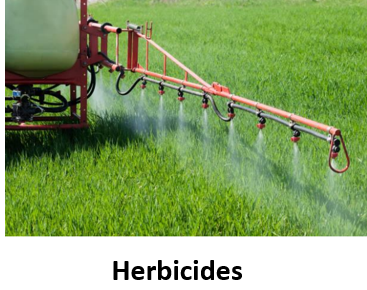
Herbicides are chemicals designed to control or kill unwanted plants, commonly known as weeds. They are a key component of weed control strategies in agriculture, landscaping, forestry, and other sectors.
Mode of Action:
- Systemic Herbicides: These are absorbed by the plant and translocated throughout its tissues, affecting various physiological processes and ultimately killing the plant.
- Contact Herbicides: These kill only the plant parts they come into contact with and typically do not move within the plant.
- Pre-emergent Herbicides: Applied before weed seeds germinate, these prevent weed growth by inhibiting seed germination or seedling development.
- Post-emergent Herbicides: Applied to actively growing weeds, these target established weeds and can be either systemic or contact herbicides.
Application Methods:
- Foliar Application: Herbicides are applied directly to the foliage of target plants using sprayers. This method is commonly used for post-emergent herbicides.
- Soil Application: Herbicides are applied to the soil surface or incorporated into the soil, targeting weed seeds or emerging seedlings. This method is often used for pre-emergent herbicides.
- Spot Treatment: Herbicides are applied only to specific weed-infested areas, minimizing the impact on non-target plants.
- Broadcast Application: Herbicides are uniformly applied over an entire area, suitable for large-scale weed control in agricultural fields or non-crop areas.
Safety and Environmental Considerations:
- Herbicides should be used according to label instructions to ensure effective and safe application.
- Proper storage, handling, and disposal of herbicides are essential to prevent environmental contamination and human health risks.
- Some herbicides may have residual effects in the soil, impacting subsequent plant growth; therefore, rotational crop restrictions and soil testing are important considerations.
- Care should be taken to minimize herbicide drift, which can unintentionally affect nearby plants or water sources.
Regulations and Labeling:
- Herbicides are regulated by government agencies to ensure their safety and effectiveness.
- Herbicide labels provide important information on proper usage, application rates, safety precautions, environmental considerations, and disposal instructions. Users must carefully read and follow label directions.
Overall, herbicides are valuable tools for weed management when used responsibly and in conjunction with other integrated weed control strategies. Proper selection, application, and adherence to safety guidelines are crucial for maximizing herbicide efficacy while minimizing environmental impact and risks to human health.