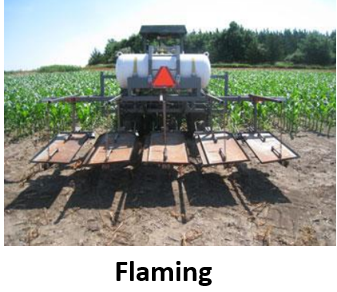
Flaming: A Comprehensive Weed Control Technique
Principle: Flaming works by exposing weeds to intense heat, typically from a propane torch or flamethrower, which causes cellular damage and ultimately kills the weeds. The heat ruptures cell walls, causing tissues to collapse and leading to desiccation (drying out) of the weed plants.
Equipment:
Propane torch or flamethrower: These devices generate a controlled flame that can be directed onto the weeds
Gas supply: Propane tanks provide the fuel for the torch or flamethrower.
Application:
Flaming is typically conducted during the early stages of weed growth when weeds are small and actively growing.
The flaming equipment is passed over the weed-infested area, and the flame is directed toward the weeds for a brief period, usually a few seconds
Effectiveness:
Flaming is effective against a wide range of weeds, including annual and perennial species, as well as germinating weed seeds.
It can be particularly useful for controlling weeds in areas where chemical herbicides are not desirable or where mechanical cultivation is impractical
Advantages:
Environmentally friendly: Flaming does not involve the use of chemical herbicides, reducing chemical inputs and potential environmental impacts.
Quick and efficient: Flaming can cover large areas relatively quickly, making it suitable for larger-scale weed control operations.
Selective targeting: With proper technique, flaming can target weeds while minimizing damage to surrounding vegetation.
Limitations:
Timing is critical: Flaming is most effective on young, actively growing weeds. Larger or more mature weeds may not be effectively killed by flaming alone.
Repeated applications may be necessary:Flaming may not completely eradicate weed populations after a single treatment, requiring multiple applications for effective control.
Weather conditions: Flaming is typically more effective under dry conditions, as wet weeds may not be as susceptible to heat damage.
Safety Considerations:
Flaming equipment should be used with caution to prevent fire hazards, particularly in dry or windy conditions.
Personal protective equipment: including gloves and eye protection, should be worn when operating flaming equipment.
Application Areas:
Flaming is commonly used in organic farming, sustainable agriculture, and landscaping settings where chemical herbicides are restricted or discouraged.
It can be employed in various environments: including vegetable fields, orchards, vineyards, and non-crop areas like sidewalks and driveways.